Why Is Multimodal Transportation Becoming a Priority for International Companies?
In today's business environment, speed, flexibility, and supply chain resilience are no longer considered competitive advantages; they have become a strategic necessity for international companies. In recent years, a series of global disruptions—including the COVID-19 pandemic, the Russia–Ukraine war, disruptions in the Red Sea and the Strait of Hormuz, rising geopolitical tensions, and volatility in transportation markets—have forced companies to rethink their logistics strategies.
In the past, many organizations focused primarily on reducing transportation costs. Today, however, factors such as risk management, reliability, route diversification, and supply chain flexibility have become increasingly important. Under these circumstances, Multimodal Transportation has emerged as one of the most effective solutions for cargo owners and international businesses.
What Is Multimodal Transportation?
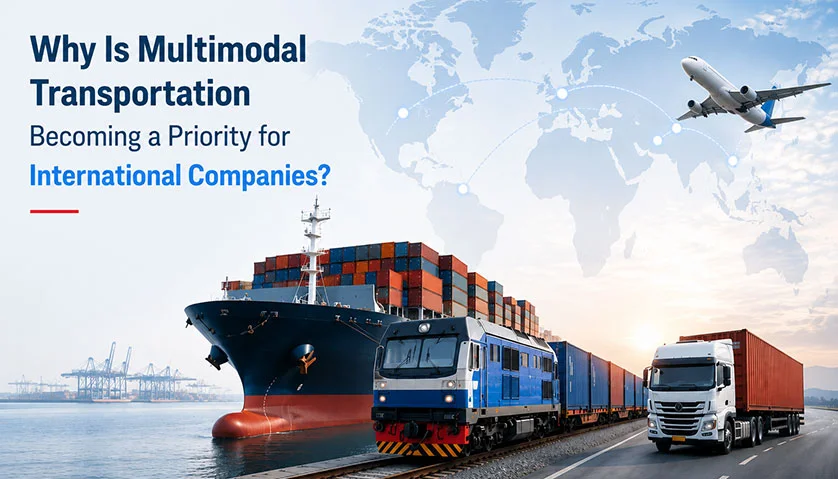
Multimodal Transportation refers to the movement of goods from origin to destination using two or more modes of transport under a single contract or managed by a single operator.
For example, a shipment may:
- Be transported from India to Bandar Abbas via Ocean Freight.
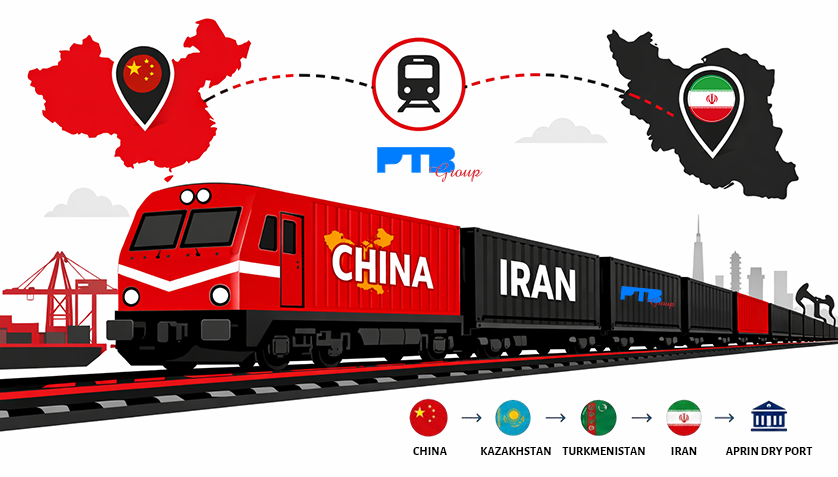
- Then be transferred through Rail Transportation to the Aprin Dry Port.
- Finally reach its destination through a Road Transportation network.
This integrated structure enables cargo owners to manage the entire transportation process through a single provider rather than coordinating multiple contractors.
The Shift in Global Supply Chain Strategy
For decades, companies designed their supply chains around the principle of achieving the lowest possible cost. However, recent global disruptions have demonstrated that the cheapest route is not always the most effective one.
Today, logistics managers are focusing on building Supply Chain Resilience rather than simply minimizing costs. As a result, multimodal transportation has become one of the most valuable tools for risk mitigation.
Red Sea Disruptions and the Importance of Alternative Routes
One of the primary drivers behind the growth of multimodal transportation has been the recent disruptions in the Red Sea and the Suez Canal.
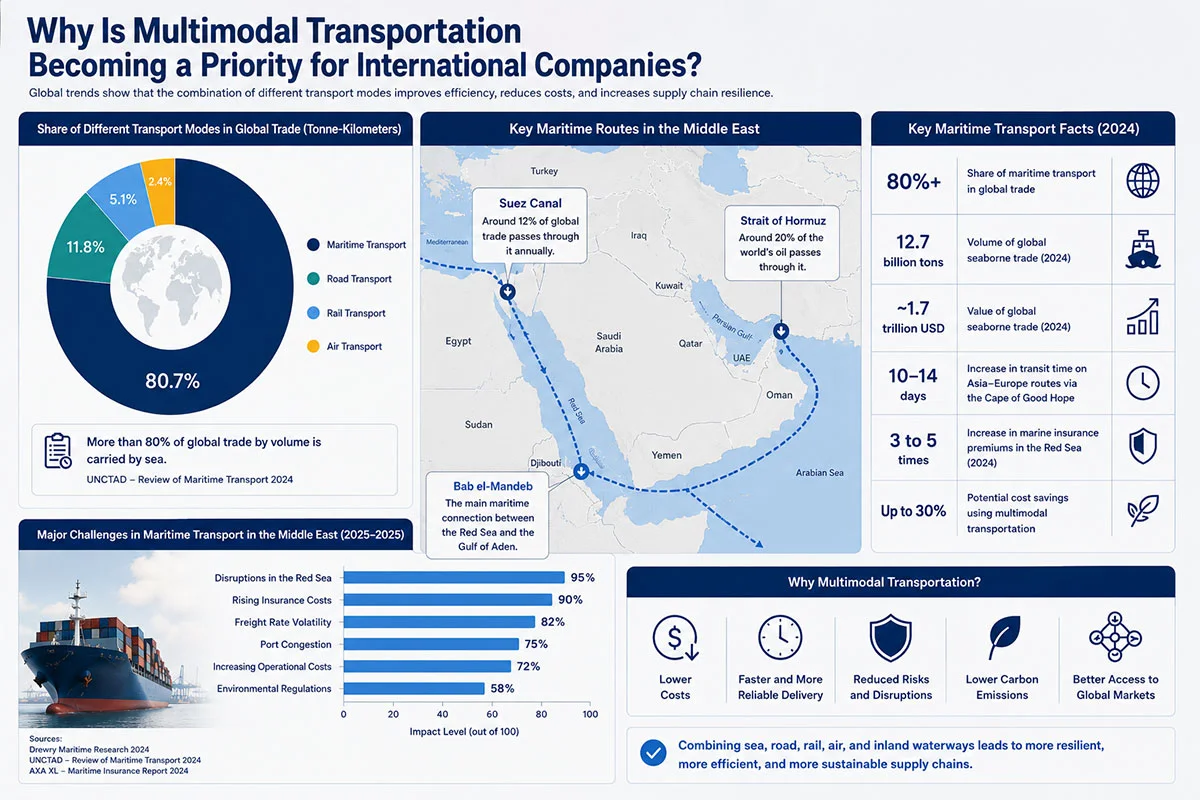
According to international reports, many shipping lines have been forced to reroute vessels around the Cape of Good Hope in Southern Africa, increasing transit times between Asia and Europe by approximately 10 to 14 days.
At the same time, rising fuel costs, insurance premiums, and transportation expenses have encouraged international companies to seek more flexible and reliable alternatives. In this context, combining ocean, rail, and road transportation has become an increasingly attractive solution.
Why Are International Companies Adopting Multimodal Transportation?
1. Greater Supply Chain Resilience
The most significant advantage of multimodal transportation is reducing dependence on a single route or transportation mode. If a port, border crossing, or maritime route is disrupted, part of the journey can be shifted to rail or road transport.
2. Reduced Geopolitical Risks
Middle Eastern tensions, the war in Ukraine, and various trade restrictions have pushed companies to diversify their transportation routes. Multimodal solutions provide a more effective way to manage these risks.
3. Improved Delivery Reliability
In industries such as automotive manufacturing, industrial equipment, pharmaceuticals, and e-commerce, delivery reliability is critical. Multimodal transportation enables businesses to utilize alternative routes and minimize delays.
4. Optimized Supply Chain Costs
Although multimodal transportation may initially appear more expensive, when considering costs associated with delays, warehousing, inventory carrying, and production downtime, it often results in lower total supply chain costs.
5. The Growth of E-Commerce
The rapid expansion of global e-commerce has increased customer expectations for faster and more predictable deliveries. Combining ocean, rail, and air transportation enables businesses to meet these demands more effectively.
The Role of Rail Transport in Multimodal Logistics
Rail transportation is one of the key pillars of multimodal logistics, playing a vital role in connecting ports to manufacturing and consumption centers.
- Lower transportation costs over long distances
- High container-handling capacity
- Reduced environmental impact
- Enhanced cargo security
- Reduced road congestion
As a result, many countries are making substantial investments in developing rail corridors and logistics terminals.
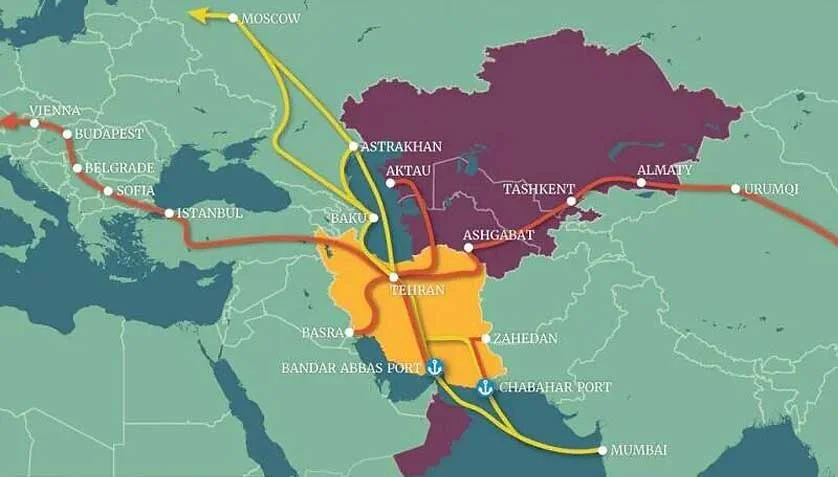
Iran: A Strategic Multimodal Transportation Hub
Iran's geographical location is one of the region's most significant logistics advantages. The country lies at the intersection of major trade corridors connecting:
- East to West
- North to South
- Central Asia to the Persian Gulf
- India to Russia
This unique position enables the development of extensive multimodal transportation networks.
The International North–South Transport Corridor (INSTC) and Its Global Importance
The International North–South Transport Corridor (INSTC) is one of the world's most significant logistics initiatives, connecting India to Russia and Europe through Iran.
The benefits of this corridor include:
- Reduced transit times
- Lower logistics costs
- Less dependence on the Suez Canal
- Greater supply chain flexibility
- Alternative routes for global trade
Within this corridor, multimodal transportation plays a crucial role, as goods move through a combination of ocean, rail, and road transportation.
Statistics Highlighting the Importance of Multimodal Transportation
According to statistics published by UNCTAD:
- More than 80% of global trade is transported by sea.
- Global seaborne trade reached approximately 12.7 billion tons in 2024.
- Red Sea disruptions increased Asia–Europe transit times by up to 14 days.
- International companies are redesigning their supply chains with a focus on flexibility and route diversification.
These figures clearly demonstrate that relying on a single transportation mode is no longer sufficient for global trade. The adoption of multimodal logistics structures has become essential.
The Future of Multimodal Transportation
Industry experts believe that the following trends will shape the future of logistics:
- Expansion of international transportation corridors
- Development of dry ports
- Digitalization of supply chains
- Integration of artificial intelligence into transport management
- Increased investment in rail infrastructure
- Development of integrated logistics hubs
Across all of these trends, multimodal transportation is expected to remain a cornerstone of future logistics systems.
Conclusion
Today's global economy has entered an era where supply chain resilience is just as important as cost efficiency. Rising geopolitical tensions, disruptions in maritime routes, transportation market volatility, and growing demand for faster deliveries have driven international businesses toward multimodal transportation solutions.
In this context, Iran has significant potential to become a leading regional logistics hub due to its strategic location along major international trade corridors. Infrastructure assets such as Shahid Rajaee Port, the country's national railway network, and the strategic location of the Aprin Dry Port near Tehran and Imam Khomeini International Airport provide seamless connectivity between ocean, rail, and road transportation.
PTB Group, through its dedicated sea port terminal in Bandar Abbas, the operational capabilities of the Aprin Dry Port, comprehensive rail, road, and international freight services, as well as supply chain management solutions, provides a strong platform for implementing advanced multimodal transportation solutions. With more than 23 branch offices across Iran and over 450 skilled logistics professionals, PTB Group helps cargo owners reduce logistics costs, improve flexibility, mitigate risks, and gain faster access to regional and international markets.
At a time when global trade requires increasingly diverse, reliable, and efficient transportation routes, multimodal transportation is no longer an option—it has become a fundamental pillar of success in the modern global supply chain.
Your email address will not be published. Required fields are marked *