DDP vs. DDU: Key Differences and DAP Explained
In international trade, one of the key issues buyers and sellers must agree on before placing an order is how responsibility for freight costs, customs formalities, and the payment of import duties and taxes will be allocated. The agreed delivery terms can affect the final transaction price, customs clearance times, unforeseen costs, and the obligations of each party.
The terms DDP (Delivered Duty Paid) and DDU (Delivered Duty Unpaid) still appear in sales contracts, pro forma invoices, and international freight forwarding arrangements. The main difference lies in who is responsible for completing import customs clearance and paying import duties and taxes in the destination country.
However, it is important to note that DDU was removed from the official Incoterms rules with the introduction of the 2010 edition. Under the current edition, Incoterms® 2020, DAP (Delivered at Place) is considered its closest equivalent.
This article examines the differences between DDP and DDU, how freight costs and transport risks are allocated under each term, why DDU was discontinued, and when DDP or DAP may be the more appropriate choice for international trade transactions today.
What Is DDP (Delivered Duty Paid)?
DDP stands for Delivered Duty Paid, a trade term under which the seller delivers the goods cleared for import, with applicable import duties and taxes paid. Under this Incoterms rule, the seller assumes extensive obligations relating to the transportation and delivery of the goods.
Under Incoterms® 2020, the seller is responsible for transporting the goods to the named place of destination, completing export and import customs formalities, and paying the applicable import duties and taxes as required by the rule. Delivery occurs when the goods, having been cleared for import, are placed at the buyer's disposal on the arriving means of transport, ready for unloading, at the named place of destination.
Under DDP, the seller's main responsibilities include:
- Preparing the goods and required documentation in accordance with the sales contract
- Arranging and paying for transportation to the named place of destination
- Completing export customs formalities
- Completing the necessary transit formalities in countries along the transport route
- Completing import customs clearance in the destination country
- Paying applicable import duties and taxes in accordance with the contractual terms and relevant regulations
- Bearing the risk of loss of or damage to the goods until delivery is completed under the DDP rule
Consequently, DDP imposes the greatest obligations on the seller among the 11 Incoterms® 2020 rules. However, this does not mean the seller is responsible for every operation at the destination without exception. For example, unloading the goods from the arriving means of transport is generally the buyer's responsibility, unless the parties agree otherwise.
Does DDP Require Delivery to the Buyer's Warehouse?
Not necessarily. The place of delivery may be the buyer's warehouse, a logistics facility, a terminal, or any other location specified in the contract.
For example: DDP Buyer’s Warehouse, Tehran, Iran – Incoterms® 2020. In this case, the seller must fulfill its DDP obligations by delivering the goods to the designated warehouse in Tehran.
However, if the contract specifies a terminal as the place of delivery, the seller is not required to transport the goods from that terminal to the buyer's warehouse unless this service has been separately agreed upon in the contract.
What Is DDU (Delivered Duty Unpaid)?
DDU stands for Delivered Duty Unpaid, a term under which the seller is not responsible for paying import duties and taxes.
Under Incoterms® 2000, DDU was one of the rules governing delivery at destination. Under this rule, the seller was responsible for transporting the goods to the named place in the destination country, while the buyer was responsible for completing import customs formalities and paying import duties and taxes.
In practical terms, under DDU, the seller arranged transportation to the agreed destination, while the buyer was responsible for import customs clearance and the associated costs. This term was particularly relevant to transactions in which the seller could arrange international transportation but was unwilling or unable to assume responsibility for importing the goods into the buyer's country.
Is DDU Still an Official Incoterms Rule?
DDU is not included in Incoterms® 2020. In its 2010 revision, the International Chamber of Commerce (ICC) removed four rules—DAF, DES, DEQ, and DDU—and introduced DAT and DAP. Since then, DDU has not been included in subsequent editions of the Incoterms rules. However, the term is still used in some commercial correspondence and international postal and express shipping services to describe shipments for which the recipient is responsible for paying import duties and taxes.
Using DDU in a new contract does not automatically invalidate the agreement, as the parties may expressly refer to the earlier Incoterms 2000 edition. Nevertheless, using the current Incoterms rules and clearly defining each party's responsibilities provides greater clarity in new contracts.
What Is the Main Difference Between DDP and DDU?
The main difference between DDP and DDU lies in who is responsible for import customs clearance and the payment of import duties and taxes in the destination country. Under DDP, these obligations fall on the seller, whereas under DDU, the buyer is responsible for completing import customs formalities and covering the associated costs. Despite this distinction, under both rules, the seller is generally responsible for transporting the goods to the named place of delivery and bears the risk of loss of or damage to the goods until delivery is completed in accordance with the applicable rule.
Why Was DDU Removed, and How Does It Differ from DAP?
In its 2010 revision, the International Chamber of Commerce (ICC) introduced DAP (Delivered at Place) to simplify the rules governing delivery at destination. This rule closely resembles DDU in terms of the allocation of import-related responsibilities.
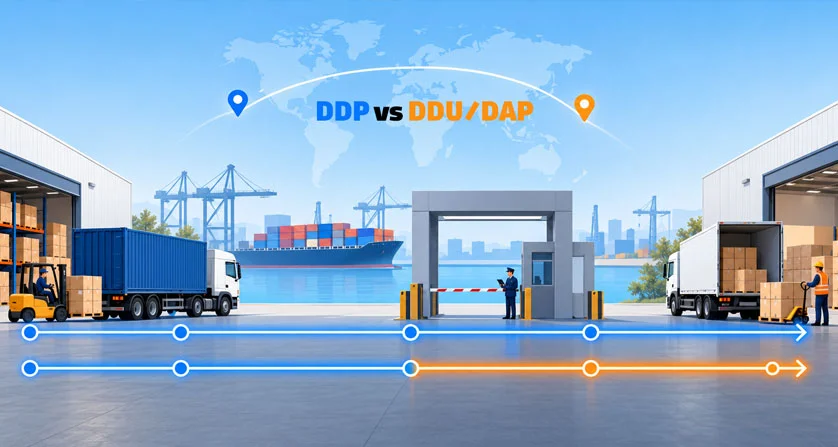
Under the DAP rule in Incoterms® 2020, the seller must arrange and pay for transportation to the named place of destination and bear the risk of loss of or damage to the goods until delivery. The buyer is responsible for completing import customs formalities and paying the applicable import duties and taxes in the destination country. Under DAP, delivery occurs when the goods are placed at the buyer's disposal on the arriving means of transport, ready for unloading, at the named place of destination.
Is DAP Exactly the Same as DDU?
No. DAP is the closest equivalent to DDU under the current Incoterms rules, but the two should not be considered identical. DDU belongs to the Incoterms® 2000 edition and must be interpreted according to that version, whereas DAP is governed by the provisions and guidance of the applicable edition, including Incoterms® 2020. For this reason, new contracts should generally specify DAP rather than DDU, together with the precise place of delivery and the applicable Incoterms edition.
For example: DAP Buyer’s Warehouse, Tehran, Iran – Incoterms® 2020. Under this arrangement, the seller is responsible for transporting the goods to the designated warehouse in Tehran, while the buyer is responsible for import customs clearance and the payment of applicable import duties and taxes.
DDP vs. DAP Under Incoterms® 2020
Since DDU is no longer an official Incoterms rule, comparing DDP and DAP is more relevant when drafting international sales contracts today. These two rules share several important characteristics. Under both rules, the seller must arrange transportation to the agreed place of delivery, pay the associated transportation costs, and bear the risk of loss of or damage to the goods until delivery is completed in accordance with the applicable rule. The key difference lies in the responsibility for import customs formalities.
Responsibility for Import Customs Clearance
Under DDP, the seller is responsible for completing import customs formalities and paying applicable import duties and taxes, whereas under DAP, these obligations fall on the buyer.
Transportation and Delivery Costs
Under both rules, the seller is responsible for paying transportation costs to the named place of destination. Therefore, it is incorrect to assume that under DAP, the buyer must cover all transportation costs incurred after the shipment enters the destination country. The seller's transportation obligations extend to the agreed place of delivery, not merely to the customs border of the destination country.
Transfer of Risk
Under both rules, the risk of loss of or damage to the goods generally transfers to the buyer when the goods are placed at the buyer's disposal at the named place of delivery, in accordance with the applicable Incoterms rule. However, if the buyer fails to fulfill certain obligations, such as completing import customs formalities under DAP, specific exceptions to the normal transfer of risk may apply under the Incoterms rules.
Unloading Responsibilities
Under both rules, the seller generally delivers the goods on the arriving means of transport, ready for unloading. Unloading at the destination is normally the buyer's responsibility. If the seller is also expected to unload the goods while the buyer remains responsible for import customs clearance, DPU (Delivered at Place Unloaded) may be a more appropriate rule to consider.
Practical Example: DDP vs. DDU for Imports from China
Consider an Iranian company planning to import industrial equipment from China. The Chinese supplier offers to arrange transportation of the goods to the buyer's warehouse in Tehran. This transaction can be examined under two different scenarios.
Scenario 1: Purchasing Under DDP Terms
Under this arrangement, the seller is responsible not only for arranging the transportation of goods from China to the agreed place of delivery, but also for completing export and import customs formalities and paying the applicable duties and taxes in accordance with the contract. Once import customs clearance has been completed, the buyer receives the goods at the designated location, ready for unloading. This arrangement may make purchasing costs more predictable for the buyer, as the seller incorporates the costs associated with its obligations into the commercial offer.
However, an important question must be considered: Is the foreign seller legally permitted to fulfill its DDP import obligations in Iran?
In many countries, commercial imports are subject to specific licensing, registration, or other legal requirements. Therefore, before agreeing to DDP terms, the parties should verify whether the seller can legally complete import customs formalities, determine who can act as the importer of record, and establish how import duties and taxes will be paid.
Scenario 2: Purchasing Under DAP Instead of DDU
Under this arrangement, the seller manages transportation to the named place of destination, while the Iranian company is responsible for completing import customs formalities and paying the applicable duties and taxes. For example, the buyer may appoint a licensed customs broker to arrange customs clearance for the shipment and subsequently take delivery of the goods at the agreed destination in accordance with the contract.
This arrangement may be more suitable for importers who can manage import customs clearance but prefer the seller to arrange international freight transport to a specified destination.
In both scenarios, the selected Incoterms rule must align with the destination country's regulations and each party's actual ability to fulfill its contractual obligations.
Is DDP Cheaper Than DDU?
It is not possible to say definitively whether DDP is cheaper than DDU. The difference between these terms primarily concerns how costs are allocated between the parties, rather than necessarily reducing the total cost of importing goods. Under DDP, the seller typically includes transportation costs, customs clearance charges, and applicable import duties and taxes associated with its obligations in the quoted price or the agreed contract price. As a result, the quoted price may be higher, but the buyer has a clearer understanding of the agreed costs from the outset.
Under DDU—and similarly under DAP, its closest counterpart in Incoterms® 2020—import-related costs are the buyer's responsibility and may be charged separately from the cost of the goods and transportation.
To assess the financial implications of the two offers, it is essential to compare their total landed costs.
Total landed cost may include the purchase price of the goods, freight charges, insurance where applicable, terminal handling charges, customs clearance fees, import duties, non-recoverable taxes, inland transportation costs, and potential delay-related charges.
Consequently, a lower initial price quoted under DAP does not necessarily mean a lower total landed cost. Similarly, a higher DDP price does not automatically make this arrangement less economical. It is also important to note that customs duties and taxes must be assessed based on the HS code, customs value, country of origin, and the destination country's regulations. Choosing DDP or DAP does not, in itself, change the applicable statutory rates.
When Is DDP a More Suitable Option?
DDP may be a suitable option when the seller has the legal authority and operational capability to handle imports in the destination country, and both parties prefer the seller to manage most of the transportation and customs clearance process. This arrangement may be appropriate for sellers operating in multiple international markets, companies with established import operations in the destination country, and transactions where clarity over the final transaction price is particularly important. However, DDP is not feasible for every trade route or destination country. If the seller is not legally permitted to complete import customs formalities, selecting DDP may result in customs clearance delays, additional costs, or contractual disputes.
Engaging an international freight forwarding company or customs broker does not, in itself, guarantee that the seller is legally authorized to fulfill all obligations under DDP.
When Is DAP a More Suitable Alternative to DDU?
DAP may be appropriate for transactions where the seller is responsible for arranging transportation to the named place of destination, while the buyer wishes to retain control over import customs clearance and the payment of customs duties and taxes. This arrangement is common in commercial imports, particularly when the buyer holds the necessary import permits, has experience managing customs clearance, or works with customs brokers in the destination country.
DAP can also be used for containerized ocean freight, rail freight, road transport, air freight, and multimodal transport.
Conversely, if the seller is legally able to handle import formalities in the destination country and both parties agree that the seller should assume these responsibilities, DDP may be considered as an alternative. Therefore, the choice between these two rules should be based on the destination country's customs requirements, the transport arrangements, each party's operational capabilities, and the total cost of the transaction.
Key Considerations When Choosing DDP or DAP in a Sales Contract
Before finalizing a sales contract, several important factors should be carefully considered:
- Incoterms edition: For new contracts, it is generally advisable to use Incoterms® 2020 and explicitly specify the agreed edition in the contract.
- Precise place of delivery: Specifying only a country or city may not be sufficient. The exact delivery point, such as a warehouse, terminal, or logistics facility, should be clearly identified.
- Import responsibilities: The contract should clearly establish which party is legally responsible for completing customs formalities and providing the required import documentation.
- Import duties and taxes: In addition to identifying the party responsible for payment, the basis for calculating applicable duties and taxes, along with whether any of those taxes are recoverable, should be assessed.
- Unloading and destination charges: The parties should clarify who is responsible for unloading, detention charges, storage fees, and any additional costs resulting from customs clearance delays.
- Cargo insurance: Under both DDP and DAP, the seller is not expressly required to obtain insurance for the buyer's benefit. However, since the seller bears the risk of loss of or damage to the goods until delivery, arranging appropriate cargo insurance coverage is an important risk management consideration.
- Destination country regulations: The legal feasibility of fulfilling DDP obligations must be assessed before pricing the transaction and entering into the contract.
In addition to specifying the applicable Incoterms rule, any additional responsibilities agreed upon by the parties should be clearly documented in the sales contract.
PTB Group's Role in Incoterms Planning and International Logistics
Choosing the appropriate Incoterms rule involves more than allocating transportation costs between the buyer and seller. The selected rule must also align with the transport route, customs regulations, cargo characteristics, place of delivery, and the operational structure of the supply chain. Selecting DDP without assessing the feasibility of import customs clearance in the destination country may expose the seller to obligations that are legally or operationally difficult to fulfill. Conversely, choosing DAP without clearly defining the buyer's import responsibilities may result in cargo delays or increased destination charges.
PTB Group, through its activities in international freight forwarding and its services covering ocean freight, air freight, rail freight, road transport, and multimodal transport, can support freight route planning and the coordination of logistics operations in line with the requirements of international sales contracts.
Assessing Incoterms rules alongside transport planning, commercial documentation, customs requirements, and destination charges helps importers and exporters make more informed decisions when managing international shipments.
Your email address will not be published. Required fields are marked *